Music Makers Manage Multiple Multimedia Models


© Peter Linder – All Rights Reserved

Long gone are the days when a record label would set a launch date, have the video played nonstop on MTV, and enjoy a clear path to record sales. The world changed irrevocably with digital video distribution and the advent of MP3 stores. So let’s see what we can learn about the future of mobile music by looking at the launch of rock star Rick Springfield’s latest record this week.

The music industry has become very creative in combining different live and multimedia innovations to create buzz for their artist. The traditional website has been customized with content targeting three different devices types: tablets, laptops/desktops and smartphones.

They have also come up with savvy ways of enticing customers to purchase the physical CDs. Music retailers will get additional promotional support by selling a special version of Rick’s new record, with four bonus songs not for sale anywhere online. Rick’s new physical album cover is also connected through an interactive application. You just download the app to your phone or tablet, and then point it at the cover to get bonus digital content on your device. The album comes with four different album covers, all with different songs and bonus content.

Last but not least, the week-long record launch in New York was made more exciting with a variety of events. Rick sang his hit “Jessie’s Girl” to New Yorkers during their morning commute on October 10 at Penn Station. The aging rocker was surrounded by commuters holding not just their take away coffees, but also their video-recording smartphones to capture the moment.

My predictions about the future of mobile music in the Networked Society:

• Mobile devices shape how music is consumed

• Comprehensive multimedia approaches with multiple innovations fundamental to creating buzz

• Live element is and will remain key in driving music revenues because live experience is impossible to bring online

• Younger generations might not understand “record” concept, but launching a collection of songs will always be a key moment for music lovers


 

Sophisticated Stations Serve Scrambling Suburban Settlers

More than 50 percent of the world’s population lives in cities, a figure that will grow to as much as 70 percent by 2050, according to our report on the future life in the megacities. This huge surge will bring 630 million people to the 40 largest metropolitan areas by 2025 – and ensuring that there is enough mobile data capacity to cover all bus, subway and train stations will be even more vital than it is today.

A central question in this development of megacities is how the availability of mobile data services will change and support commuters traveling to and from work. The time spent commuting is already very long, and growing cities will not be able to reduce this. So it becomes critical that people can use this time to be productive, and accomplish important private and personal business.

Commuters carry their digital devices everywhere, and their ability to use them along commuting routes is a major need to address. Some use their devices on the bus/train/subway, but most pull out their devices at stations when they transit. The demand for coverage and capacity at stations is now growing quickly, and it is the new data applications driving the demand.

There are very unique business challenges, however, in equipping all stations in a heterogeneous network. There is not an immediate revenue upside but a negative downside from commuter churn if the stations are underserved. But the majority of the Distributed Antenna Systems and Small Cells about to be deployed will be justified through the opportunities for churn reduction and the high value to society. Just imagine the stress on a 21st century professional commuting to and from the city if he or she could not use the time in a constructive way.

My predictions for the future of connectivity at train, metro and bus stations:
• Network coverage and capacity for commuters is vital in enabling projected megacity growth
• Stations will be equipped with powerful 3G/4G/WiFi solutions to serve commuters
• New business models and solutions will change the business case substantially, enabling gains both for commuters and operators
• Failure to meet commuters demand is likely to be a significant driver for churn.

Travel Transition To Total Trip Treasures


Planning our vacations and trips is already networked. We book flights, cars and hotels online. We find our way with GPS, and we share the daily highlights of our trips through social media. So what else is around the corner that can simplify our travel plans?

As more and more of us become smartphone owners, I think local tour companies could send short promotional videos about their offerings to visitors upon arrival at our hotel, so we don’t have to flip through paper brochures in the hotel lobby and maybe miss theirs.

When you book a tour, each tourist’s mobile number could be registered in the host’s mobile computer, so they can send us details about pickup and drop-off times, delays and other additional information via text.

Social-media tools have the potential to be used to check in for excursions, replacing the handling of paper vouchers and booking receipts. Enhanced driving directions through GPS could allow drivers to drive in less developed places, and perhaps even translate foreign road signs as we pass them. And while the printed guidebook will still be with us for a while longer, I expect most of them will be distributed online, optimized for smartphone rather than PC access.

In addition to all of the above possibilities, wouldn’t it be wonderful if taxis all around the world accepted payment by card or smartphone. I think this is one of the main reasons why people still need to change money into local currencies. Taxi drivers in many countries still do not accept credit cards, even in London, and most travelers don’t like to carry cash. Perhaps new smartphone-based payment applications such as the taxi app in New York will allow us to meet halfway.

What would make your next trip run a little more smoothly?

Trio Trigger Tablet Thriller

The phone, the tablet and the hybrid of the two, referred to as the phablet (it’s bigger than a smartphone, but smaller than a tablet) are three key devices that are becoming more and more essential to the 21st-century corporate worker.

Three operating systems (OSs), namely Google Android 5, Apple iOS 6 and Windows 8, and the three network interfaces that make them useful everywhere – Wi-Fi, 3G and 4G – are triggering a new wave in the device market with its new characteristics and high potential to re-shape the workplace.

Initially, OS releasesprimarily targeted the market for devices with 3-4in (about 7.6-10.1cm) screens (smartphones). Later, they were optimized for the market for devices with 10in (about
25.4cm) screens (tablets), where the bulk of the devices sold came with a Wi-Fi interface only. Today, smartphone screens are generally becoming bigger, meaning they are 3-4.5in (about 7.6-11.4cm) wide, but tablet screens are shrinking to 7-10in (about 17.8-25.4cm).

For the first wave of tablets, purchased primarily for private use, Wi-Fi was judged by most users as only OK.  But today the tablet has the potential to become one of the two key devices that knowledge workers depend on for their working lives, the other being the smartphone. Therefore, we can expect a Wi-Fi/3G/4G interface to become the standard for tablets, as professional users will expect tablets to work wherever smartphones do.

What’s also important to note is that applications used to be optimized for each device type. Today, however, the borders between devices and applications have almost been eliminated, and new OSs provide an integrated experience across a variety of screen sizes and device categories.

I wonder what we’ll call a device with a 6in (15.2cm) screen, once it exists.

Time To Turn To Tablet Tomorrow

© Peter Linder – All Rights Reserved

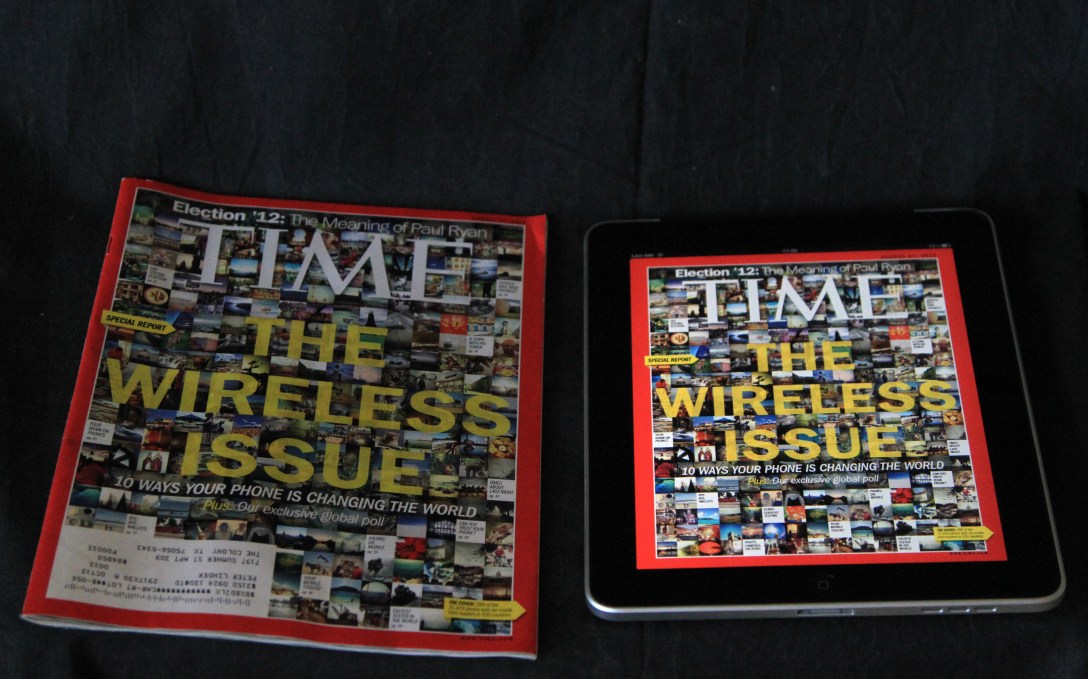
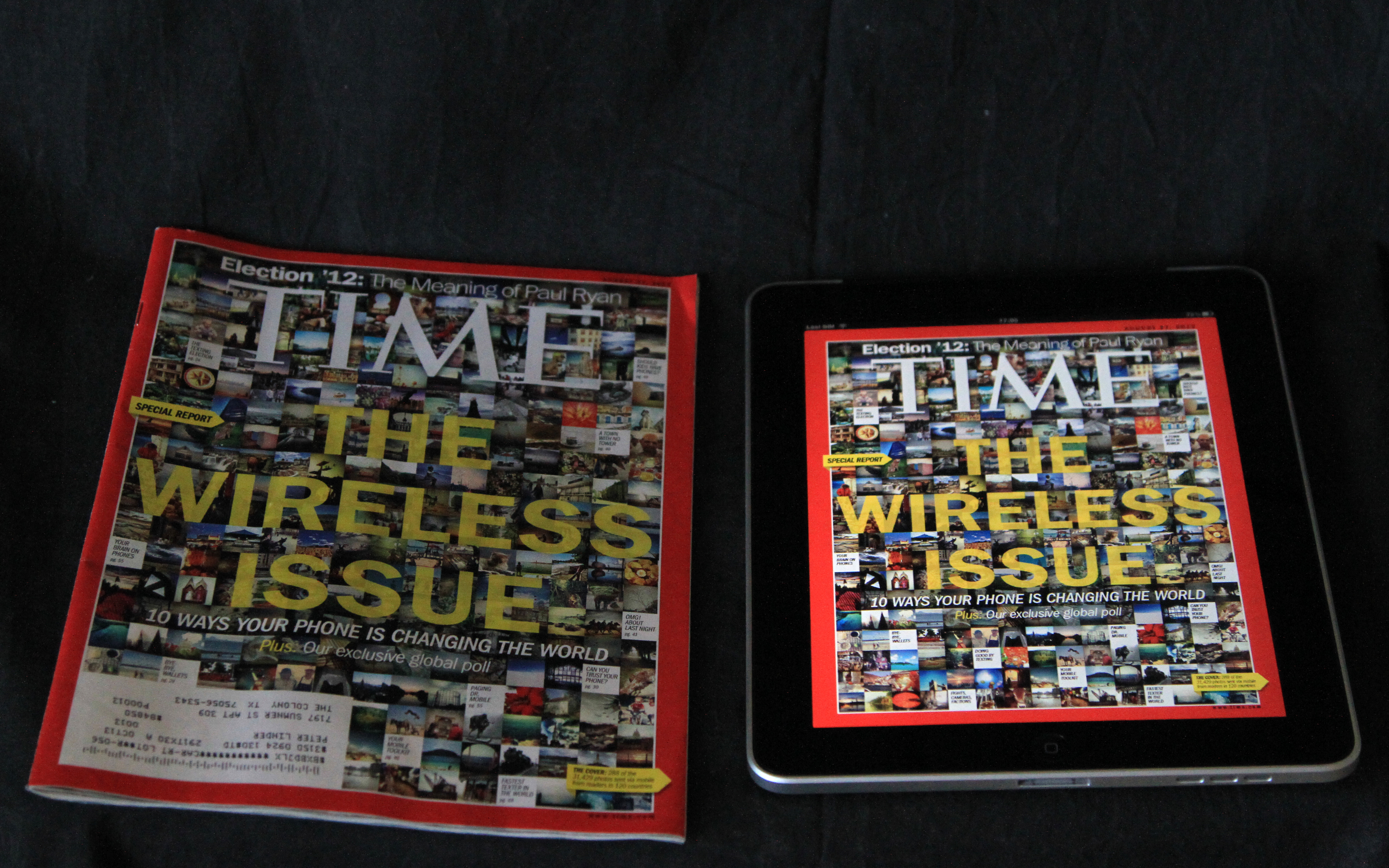
Over the next five years, many print magazines will be transformed into digital publications. Digital magazines will come in two forms: a downloaded version that is available offline, and a networked cloud version that readers can access in real time.

As I flipped through a pile of magazines during my summer vacation, I realized the paper experience might be over sooner than we think. But it’s not all bad news, is it?

E-books and tablets are rapidly changing the distribution and sales processes for magazines and books, as well as the way we consume content. However, if you’re not yet an avid user of an e-reader and you haven’t even begun to transform your reading habits from paper to portable screen, there’s no cause for alarm – well, not just yet. While many of us are adapting to new technologies to consume our favorite content, more popular magazines will continue to exist in print. It’s all a matter of keeping the magazine’s audience happy by offering alternative formats while these are still required.

As larger chunks of the magazine audience move to electronic formats, I do expect the paper experience to become less common. Printing and distribution expenses make up a significant share of the production costs for paper magazines. As much as readers may love the printed versions of their favorite magazines, the overhead costs could force publishers to move to networked magazines only. Already, most magazines come with a subscription, or single-issue purchase, which includes access to an electronic version as an incentive to encourage readers to try the on-screen version.

The primary challenge for magazine publishers is to figure out how to maintain their readership so that advertisers stay on board during the transformation process. How do publishers ensure that their magazines can continue to attract readers after the transition? And how do they reassure advertisers that they can continue to reach their target audience even if the format changes? US subscribers can now subscribe to most magazines at only USD 1 per issue. It will be interesting to follow the business-model innovation for networked magazines in the future; we may see paper/electronic hybrids as well as pure networked-only versions.

I see a bright future ahead. Digital publications will make it possible to open up new advertising models with greater accuracy in terms of measuring the actual viewing of ads and the impact of each ad. The audience will be given access to video capabilities, adding a whole new dynamic to the magazine experience, and the marketing department will have the ability to share the magazine with a wider audience through effective social-media channels.

Cradle citizenship creates changed community


All kids born in 2012 will have dual citizenship; one, or several will be connected to their parents and where they were born, and one will be in the Networked Society.

Kids today are growing up in a digital world with access to devices 24/7. They are using many of these devices, such as tablet computers, three to four years before they even know how to read or write. Responsible use of devices and applications is not intuitive, and an early challenge for parents is to educate kids on what is good and what is bad device usage. This is sometimes tough because as a parent, you are likely to be behind in understanding your kids’ devices and their applications.

In a world where anyone can publish anything, being able to judge information critically is a vital skill needed from an early age. Kids need to know what editing tools can do to pictures and videos, and how easy it is to tweak reality. In addition, texts become more and more subjective the larger the base of writers and the closer the topic is to someone’s heart. Perhaps it was simpler in a world where the bulk of text and pictures in books had to go through some kind of editorial and approval process before they were deemed true.

However, one of the positive things about the emergence of the Networked Society is the opening up of cultural borders. As kids develop worldwide relationships earlier in life, they discover a deeper understanding of different cultures. What baby boomers learned through many years of international travel can now be quickly learned by our children just by living in the Networked Society. One thing that needs to be ensured is people’s manners; politeness is the ingredient to all successful digital communication in the Networked Society.

In my generation, professional skill sets were developed around key knowledge areas and hard work. The skill sets of our kids will be very different, and to a larger extent will be based on their ability to create, contribute and collaborate with others. The rules and guidelines for such work are more complex and less intuitive.

I predict that some of the demands on the children born with a Networked Society citizenship will be that:

* Their global Networked Society citizenship will expose them to a broader range of cultures very early in life.

* Their ability to critically judge information, and to do so quickly, will be vital to thrive in an information-centric society.

* They could be dependent on 50-100 devices in a household and that “device illiteracy” could put them at a significant disadvantage in the Networked Society.

* The analog world still has a lot to offer, and Networked Society citizenship should come on top of the analog world and cultures.