
Billing Beyond Bits & Bytes

© Peter Linder 2012 – All Rights Reserved      Canon 7D | 8-15mm/4 | ISO 100 | 1/250 s | F10
© Peter Linder 2012 – All Rights Reserved      Canon 7D | 8-15mm/4 | ISO 100 | 1/250 s | F10

Today’s most common broadband business model – fat pipe at a flat rate – was launched in 1996 when ADSL and cable came along. The model was re-used when mobile broadband was introduced in 2005. But should this classic business model be used in all networked industries? How do we deal with traffic volumes that can differ by thousands of times among applications that generate similar revenues?

In my daily life, I use three applications with widely differing price and traffic patterns:

  • A smartphone with a data limit , costing tens of dollars per month for 2GB of traffic
  • A Netflix subscription costing dollars per month and generating 30GB of traffic
  • A work environment (mobile, desktop and associated data services) costing hundreds of dollars for 10-50GB of traffic.

All three of these services can be provided with mobile access. It’s hard to see how dollar values spanning from tens of dollars per GB to only a few cents per GB can and should be supported using a single billing base, namely the number of bits and bytes that are transported. Since the value delivered is becoming more and more decoupled from the amounts of bits and bytes transported, and in many cases correlates negatively with traffic volumes, new business models are inevitable.
Imagine what would happen if a hamburger restaurant adopted a unit price per calorie of food. If this were applied to the standard menu, the prices would be very high for burgers and fries – and very low for salads. As a direct result, burger sales could be expected to fall sharply, and sales of salad would shoot up. It would be hard to run a sustainable restaurant business using this kind of business model.

We now have the potential to deliver exceptional added value on mobile broadband. Business-model innovation is essential if we are to capture this generated value. Otherwise, it will be difficult to continue funding the required investments for 3G/4G/Wi-Fi network infrastructure expansion and modernization.

My forecasts for the future of networked business models are:

  1. Business-model innovations will focus on  5 to 15 % of mobile broadband traffic that is most valuable
  2. The billing base for these services will be linked to new kinds of service-level agreements involving one or several new connectivity attributes such as latency, latency variation, availability, reliability, security, integrity and coverage
  3. The factor determining how platinum or gold services and users are defined will shift from “who uses the most network resources?” to “which services or users generate the most revenue or the best margins?
  4. Most business-model innovations will involve higher charges for service providers, to be bundled into the overall price per service.

Mobile networks are among the most advanced infrastructures in business today, and there’s no reason that the value captured in these networks should decline as the value added to adjacent industries increases substantially over time.
Device Diversification Drive Daunting Data Destiny

As a communications industry veteran who works at the forefront of fore sighting, it’s not a surprise that I own 28 digital devices and am likely to be one of the most advanced device users in the world. But I’ll tell you what is remarkable, and that is that the gap between the devices my sister and I own is continuously shrinking. The devices in her family are no longer light-years behind mine; in fact they are sometimes even ahead! And these devices are gaining the ability to connect to networks at a very fast pace.

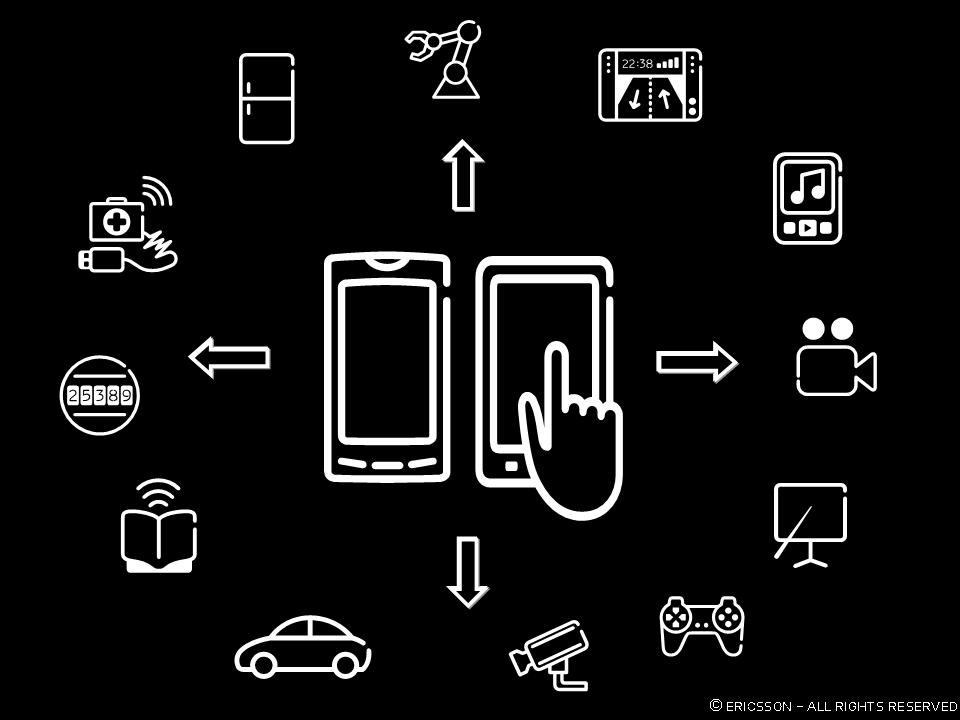
These days, devices can be divided into two distinct categories. The first category refers to connected consumer electronics, where users purchase the device and network connectivity either comes separate or is integrated with a service fee of some sort. Think tablets, internet TVs, game consoles, Blu-ray/hard disk drive players, digital cameras, fridges, heating, ventilation and air-conditioning (HVAC) equipment and so on. This category, to a large extent, leverages internet connectivity the way we know it today.

The second category refers to devices that are an integrated part of adjacent industries’ service offerings. As a user you purchase a service and the devices are used as part of the service delivery chain. Think connected electricity meters, connected security cameras, connected eBooks, connected vehicles and so on. The devices associated with the transformation of an adjacent industry require a lot of cross-industry collaboration work. They also affect OSS/BSS platforms and require networking attributes beyond best-effort internet connectivity.

For example, I find the car to be a very fascinating cross-industry collaboration arena:

* Car manufacturers want to be connected to my car for proactive maintenance planning

* Entertainment companies want to connect to the screens and loudspeakers in my car

* Insurance providers want to be connected to my car to monitor responsible driving

* Road authorities want to connect to my car for road charges and hazard warnings

* Navigation service providers want to connect to my car to provide proactive route planning

Looking ahead, I predict that devices will remain separated into these two radically different device categories. However, most connected device innovations will require significant cross-industry collaboration. This means that large business model and ecosystem shifts will eventually require a transformation to networked industries, which will result in a reshaping of regional, national or global markets.

I’d like to conclude by posing a question, what devices do you expect to materialize in the future, and how would they benefit your world?

Significant Society Shaping Started!

© Peter Linder 2012 – All Rights Reserved
© Peter Linder 2012 – All Rights Reserved      Canon 7D | 8-15mm/4 | ISO 200 | 1/30 s | F4

Over the past few years I have seen Ericsson’s vision of the Networked Society evolve,creating opportunities that benefit the way we live, work and play. But where did the concept of the Networked Society come from? How can the journey be quantified? What future predictions can be made?

In the spring of 2008 an Ericsson team drew a simple graph on a whiteboard to stimulate a brainstorming session. The context was simple. The global potential for fixed broadband is restricted to just north of 1 billion physical locations, then we run out of houses and offices. Similarly, the market for mobile broadband is restricted to around 5 billion people. So what’s next? The next big wave, which is already under way, is to move beyond people and go after digital devices that can benefit from being connected. We picked 50 billion as a hypothesis for the size of this next wave.

Connecting the first 5 billion people with mobile phones was only possible as a result of significant industry collaboration between mobile operators, terminal providers and network providers.

To journey from 5 billion to 50 billion we made two assumptions:

  • Users in the Networked Society will be dependent on many more digital devices in the future and each user will have 10X (an order of magnitude) connected devices
  • The Networked Society will not be created by the mobile communications industry alone, 10X adjacent industries will be involved

Connected devices that aren’t PCs, TVs or mobile phones will generate only one-tenth of the average revenue per user.And those assumptions weren’t far off. More and more devices are becoming available, connecting people and things.These are my predictions for the future:

  • 50 billion = 5 billion (people) times 10X (devices) times 10X (industries) times 1/10 (ARPU) is a reasonable assumption for growth in the coming decade
  • Significant cross-industry collaborations will continue to connect the world’s biggest machine (the global network)  –  50 billion connected devices –  to adjacent industries
  • Within 5 years,the norm for the most advanced users of devices today will become the norm for the mass market
  • The changes that take place in digital mobile communication over the next 5 years will be greater than those that have taken place in the previous 20.

I think these figures back up our bold statement “When one person connects, their life changes. With everything connected, our world changes.” A connected world is just the beginning.