Petabytes Placement Power Plant

Heterogeneous networks deployment needs the new 4Ps

The 4Ps – Product, Place, Price and Promotion – are widely used as a marketing baseline. When it comes to planning heterogeneous networks, it would be great to see Petabytes, Placement, Power and Plant gain similar industry mindshare.

Heterogeneous networks use a mix of large and small radio cells to provide optimal coverage and performance. They bring a lot of benefits, but also a few challenges. That’s where the new 4 Ps come in.

With PETABYTES, it’s all about understanding the traffic patterns. The expected evolution over time, and the price/performance considerations between available access technologies, are all factors to consider. This becomes increasingly delicate as device and service types grow exponentially. In addition, there is a lack of correlation between traffic volumes and revenues in the future.

The physical PLACEMENT of a cell is critical. A small cell has one optimal location from a performance perspective, and the shorter radio reach limits the ability to deviate from that optimal location. Indoor and outdoor placements impose different constraints on the deployment of small cells.

The POWER challenge is twofold, involving both primary and secondary (back-up) power. There are different options for a primary power source, AC or DC. If there is no existing power supply, one has to be designed and deployed. Back-up power could be more complex, with restrictions, for example, on how and where batteries can be placed.

The existing PLANT – such as fiber, copper and coax wires – determines the backhaul options. The simplest scenario is to reuse the existing wiring. A radio scenario is attractive when no wiring exists and can’t be installed easily. Extending fiber, and power, to optimal cell locations can make business sense for specific applications.

I predict that we will see four trends emerge as heterogeneous networks become more popular:

  • Deployment strategies will be built on a clear view of the Petabytes, Placement, Power and Plant scenario for each specific site and situation
  • Many operators will want to get their cells into the same optimal locations, and may have to share cells in order to avoid inferior placements
  • Property owners are interested in preparing their buildings with power and backhaul wiring suitable for optimal small-cell deployment locations, to make them attractive for potential tenants
  • There will be many urban deployment use cases developed, with very different traffic scenarios during the time of the year (temporary needs) and day (permanent needs)


Nascar nights – Not Normal Network Needs

Major sports events are being networked to an ever greater extent. The National Association for Stock Car Auto Racing (NASCAR), for example, provides several tools for fans watching a live event.

Radios, called race scanners, are available so fans can follow the communication between drivers and their crews during a race. The leaderboard is available in your smartphone, so you can stay up-to-date on the drivers’ positions. And recently, Brad Keselowski made history by becoming the first driver to tweet while racing (during a stoppage).

At each race, mobile-network coverage is needed for up to 192,000 fans as well as the teams of the 100 participating cars. In addition to having coverage inside the venue, parking-lot coverage for pre-race tailgating is vital. The network demand at such events is far from normal and requires temporary reinforcement. This requires and add-on network, which is designed as a complement to the existing network.

Ericsson supports race sponsor and US operator Sprint with a managed-network solution for such events.Two teams and two complete equipment setups cover the 38 yearly events on a rotating scheme. For a venue like the Texas Motor Speedway, five Cells on Wheels (COW) are deployed. COWs are mobile cell sites containing antenna towers and electronic radio transceiver equipment on trucks or trailers. The temporary addition is designed with two COW inside the venue with six antenna elements and three outside with three antenna elements each.

I was given the opportunity to visit the Ericsson support team during the race in Texas on April 14, and I was truly amazed by several things:

  • It takes just three days to assemble the temporary network
  • More than 50 transmission links need to be connected
  • The mix of 3G, 4G and Wi-Fi represents a very “dirty” radio environment, calling for careful network design and optimization
  • The data capacity is three-and-a-half times larger than the current data capacity for voice
  • NASCAR does not allow teams to collect any telemetry data beyond fuel injection mapping, and the collected data is published for all to see.

The debate has begun on the role of networks in enhancing the fan experience in sport, and some feel that tweeting is distracting the drivers or athletes. But having gained more than 100,000 new Twitter followers in one day, @keselowski is clearly breaking new ground.

My predictions for the future of networked sports are that:

  1. All major sports arenas will upgrade mobile-data access within three years for capabilities to deliver seamless 3G/4G/Wi-Fi access to the devices of fans and the staff supporting the sport
  2. Online experience at the venue will be an integrated part of live events
  3. Innovations around social media, TV and mobile devices are key in attracting new generations of fans
  4. Spectators will use smartphones and soon bring tablets for replays and special statistics at the venue, as a complement to the jumbo TV screens already in place 

Pitching & Putting – Powerful Personal Production


© Peter Linder 2012 – All Rights Reserved


It is rare that a Masters Golf Tournament features so many Swedes in contention for the final round. And this year there were four: Peter Hanson, Henrik Stenson, Fredrik Jacobson and Bubba Watson. But is this what I enjoyed most about watching this year’s Masters – or was it that I was able to create a truly unique, personalized viewer experience for myself?

This year, for the first time, I was able to view four different channels at once: two featured player groups and two featured parts of the course. I could then choose which screen I wanted to follow, or watch all four screens simultaneously.

Being able to get specific statistics from the dedicated Masters app made the experience complete. Not only did I get access to information about the primary leaderboard, I was also able to receive updates on the progress of the other players I chose to follow. And to me that was really important.

To improve my viewing experience even further, next year I would like to watch the tournament with a more extensive offering of camera angles. This should be possible, given that consumers continue to embrace the shift toward multi-screen and multi-network TV services.

For more than 30 years, innovation has been a part of the production of sports TV. Most significantly, we’ve seen the overlaying of graphics on a live TV signal and the transition to HDTV cameras. And with more and more advanced TVs, tablets and phones, producers will continue to find new ways to hold viewers’ attention – 3DTV, five-channel audio and a range of camera-angle selections are just a few examples.

The multi-platform, multi-screen future is changing the way we interact with our content. Here are some of my predictions about the future of viewing live sports TV:

  1. Users will be given a choice between the main production and the editor’s choice version, while following the game through multiple cameras
  2. Viewers will be able to access additional statistics about the game through a companion screen rather than the main screen
  3. Users will control what appears on the main screen through a tablet that acts as a remote control
  4. The viewing experience will be a blend of the broadcast on the main screen and interactive features on a companion screen
  5. In a few years’ time, golf players will be allowed to have their phones on during tournaments to interact with fans through social media
  6. New business models and advertising options will evolve for the TV experience that we produce ourselves.


Powerful Personal Pitching & Putting Production

© Peter Linder 2012 – All Rights Reserved

It is rare that a Masters Golf Tournament features so many Swedes in contention for the final round. And this year there were four: Peter Hanson, Henrik Stenson, Fredrik Jacobson and Bubba Watson. But is this what I enjoyed most about watching this year’s Masters – or was it that I was able to create a truly unique, personalized viewer experience for myself?

This year, for the first time, I was able to view four different channels at once: two featured player groups and two featured parts of the course. I could then choose which screen I wanted to follow, or watch all four screens simultaneously.

Being able to get specific statistics from the dedicated Masters app made the experience complete. Not only did I get access to information about the primary leaderboard, I was also able to receive updates on the progress of the other players I chose to follow. And to me that was really important.

To improve my viewing experience even further, next year I would like to watch the tournament with a more extensive offering of camera angles. This should be possible, given that consumers continue to embrace the shift toward multi-screen and multi-network TV services.

For more than 30 years, innovation has been a part of the production of sports TV. Most significantly, we’ve seen the overlaying of graphics on a live TV signal and the transition to HDTV cameras. And with more and more advanced TVs, tablets and phones, producers will continue to find new ways to hold viewers’ attention – 3DTV, five-channel audio and a range of camera-angle selections are just a few examples.

The multi-platform, multi-screen future is changing the way we interact with our content. Here are some of my predictions about the future of viewing live sports TV:

  1. Users will be given a choice between the main production and the editor’s choice version, while following the game through multiple cameras
  2. Viewers will be able to access additional statistics about the game through a companion screen rather than the main screen
  3. Users will control what appears on the main screen through a tablet that acts as a remote control
  4. The viewing experience will be a blend of the broadcast on the main screen and interactive features on a companion screen
  5. In a few years’ time, golf players will be allowed to have their phones on during tournaments to interact with fans through social media
  6. New business models and advertising options will evolve for the TV experience that we produce ourselves.

Billing Beyond Bits & Bytes

© Peter Linder 2012 – All Rights Reserved      Canon 7D | 8-15mm/4 | ISO 100 | 1/250 s | F10
© Peter Linder 2012 – All Rights Reserved      Canon 7D | 8-15mm/4 | ISO 100 | 1/250 s | F10

Today’s most common broadband business model – fat pipe at a flat rate – was launched in 1996 when ADSL and cable came along. The model was re-used when mobile broadband was introduced in 2005. But should this classic business model be used in all networked industries? How do we deal with traffic volumes that can differ by thousands of times among applications that generate similar revenues?

In my daily life, I use three applications with widely differing price and traffic patterns:

  • A smartphone with a data limit , costing tens of dollars per month for 2GB of traffic
  • A Netflix subscription costing dollars per month and generating 30GB of traffic
  • A work environment (mobile, desktop and associated data services) costing hundreds of dollars for 10-50GB of traffic.

All three of these services can be provided with mobile access. It’s hard to see how dollar values spanning from tens of dollars per GB to only a few cents per GB can and should be supported using a single billing base, namely the number of bits and bytes that are transported. Since the value delivered is becoming more and more decoupled from the amounts of bits and bytes transported, and in many cases correlates negatively with traffic volumes, new business models are inevitable.
Imagine what would happen if a hamburger restaurant adopted a unit price per calorie of food. If this were applied to the standard menu, the prices would be very high for burgers and fries – and very low for salads. As a direct result, burger sales could be expected to fall sharply, and sales of salad would shoot up. It would be hard to run a sustainable restaurant business using this kind of business model.

We now have the potential to deliver exceptional added value on mobile broadband. Business-model innovation is essential if we are to capture this generated value. Otherwise, it will be difficult to continue funding the required investments for 3G/4G/Wi-Fi network infrastructure expansion and modernization.

My forecasts for the future of networked business models are:

  1. Business-model innovations will focus on  5 to 15 % of mobile broadband traffic that is most valuable
  2. The billing base for these services will be linked to new kinds of service-level agreements involving one or several new connectivity attributes such as latency, latency variation, availability, reliability, security, integrity and coverage
  3. The factor determining how platinum or gold services and users are defined will shift from “who uses the most network resources?” to “which services or users generate the most revenue or the best margins?
  4. Most business-model innovations will involve higher charges for service providers, to be bundled into the overall price per service.

Mobile networks are among the most advanced infrastructures in business today, and there’s no reason that the value captured in these networks should decline as the value added to adjacent industries increases substantially over time.

Device Diversification Drive Daunting Data Destiny

As a communications industry veteran who works at the forefront of fore sighting, it’s not a surprise that I own 28 digital devices and am likely to be one of the most advanced device users in the world. But I’ll tell you what is remarkable, and that is that the gap between the devices my sister and I own is continuously shrinking. The devices in her family are no longer light-years behind mine; in fact they are sometimes even ahead! And these devices are gaining the ability to connect to networks at a very fast pace.

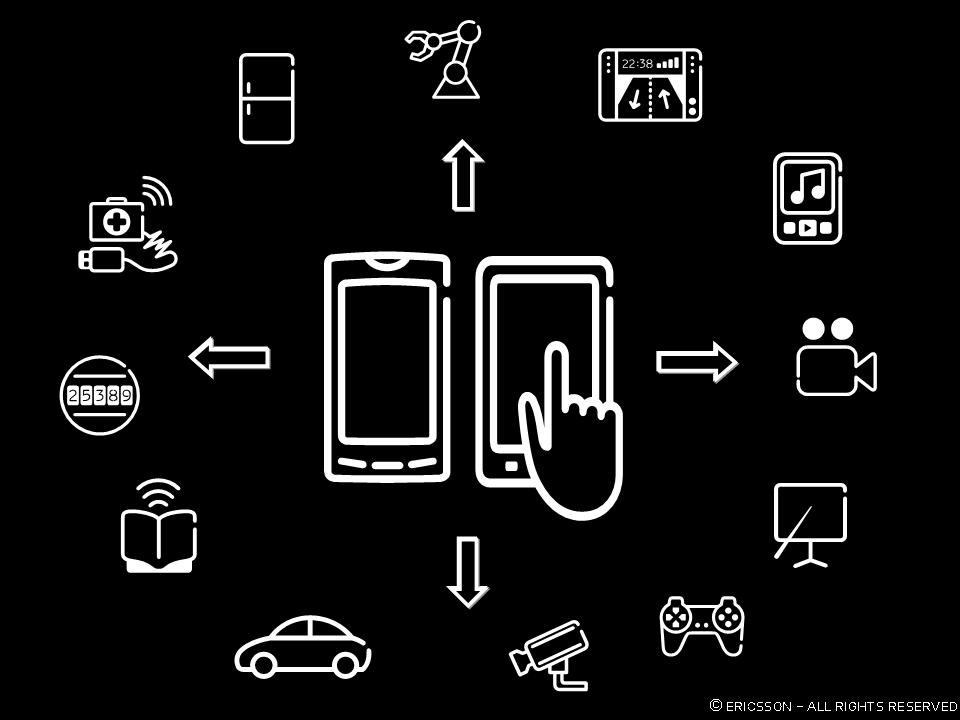
These days, devices can be divided into two distinct categories. The first category refers to connected consumer electronics, where users purchase the device and network connectivity either comes separate or is integrated with a service fee of some sort. Think tablets, internet TVs, game consoles, Blu-ray/hard disk drive players, digital cameras, fridges, heating, ventilation and air-conditioning (HVAC) equipment and so on. This category, to a large extent, leverages internet connectivity the way we know it today.

The second category refers to devices that are an integrated part of adjacent industries’ service offerings. As a user you purchase a service and the devices are used as part of the service delivery chain. Think connected electricity meters, connected security cameras, connected eBooks, connected vehicles and so on. The devices associated with the transformation of an adjacent industry require a lot of cross-industry collaboration work. They also affect OSS/BSS platforms and require networking attributes beyond best-effort internet connectivity.

For example, I find the car to be a very fascinating cross-industry collaboration arena:

* Car manufacturers want to be connected to my car for proactive maintenance planning

* Entertainment companies want to connect to the screens and loudspeakers in my car

* Insurance providers want to be connected to my car to monitor responsible driving

* Road authorities want to connect to my car for road charges and hazard warnings

* Navigation service providers want to connect to my car to provide proactive route planning

Looking ahead, I predict that devices will remain separated into these two radically different device categories. However, most connected device innovations will require significant cross-industry collaboration. This means that large business model and ecosystem shifts will eventually require a transformation to networked industries, which will result in a reshaping of regional, national or global markets.

I’d like to conclude by posing a question, what devices do you expect to materialize in the future, and how would they benefit your world?